2020 timeline contents
2020-2035 – World oil crisis
2020 – Generation X is reshaping global politics | Internet use reaches 5 billion worldwide | The 5G standard is released | Texting by thinking | Complex organ replacements grown from stem cells | A cure for malaria | Progress with longevity extension | Ultra High Definition Television (4320p) is going mainstream | Holographic TV is going mainstream | Africa and the Middle East are linked by a trans-continental bridge | Hong Kong's Mass Transit Railway (MTR) has been significantly expanded | The first self-sufficient, car-free city in mainland China | Completion of the Fehmarn Belt Fixed Link | The UK has expanded its offshore grid connections | Smart meters in every UK home | Public smoking is banned across every US state | Mercury pollution has been greatly reduced | Glacier National Park and other regions are becoming ice-free | 30,000 drones are patrolling the skies of America | BepiColombo arrives in orbit around Mercury | Video games with truly lifelike CGI
2020-2035
World oil crisis*
Throughout this period, the world is thrown into turmoil as demand for oil begins to greatly exceed supply – crippling many economies and triggering widespread social unrest.*
Throughout this period, the world is thrown into turmoil as demand for oil begins to greatly exceed supply – crippling many economies and triggering widespread social unrest.*
There are conflicts in Africa, Asia and the Middle East where millions die from starvation, war and civil disruption. Many countries in the West experience a decline in living standards, with oil rationing and conservation measures introduced by governments. Sharp reductions in travel, tourism and aviation leads to increased localisation of goods and services.
The crisis plays out for over a decade, gradually being resolved by a shift to renewable energy,* electric vehicles* and alternative liquid fuels. The transition is by no means a smooth one, however. It requires nothing less than an all-out Manhattan Project on a global scale. By 2035, the geopolitical map of the Middle East is unrecognisable, while China has reaped significant political and economic gains from the US.

Internet use reaches 5 billion worldwide
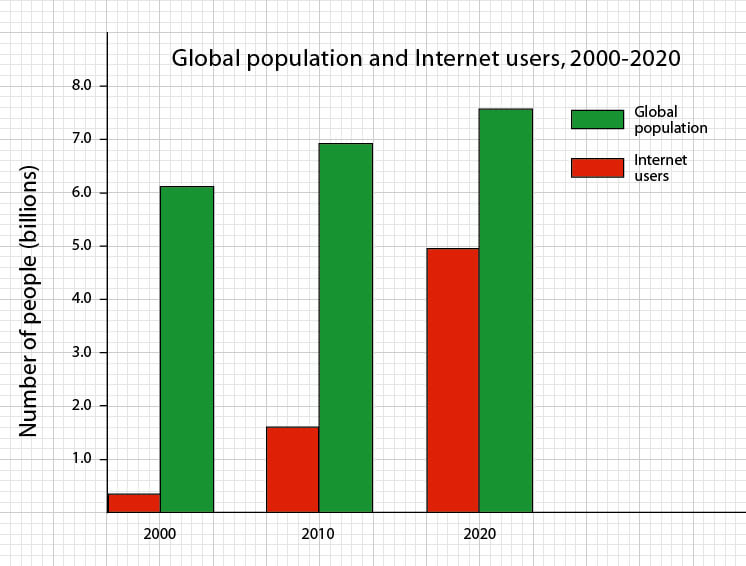
The number of Internet users has now reached almost 5 billion – equivalent to the entire world's population in 1987. This compares with 1.7 billion users in 2010 and only 360 million in 2000.*
Vast numbers of people in developing countries now have access to the web, thanks to a combination of plummeting costs and exponential technology improvements. This includes laptops, smartphones and tablet devices that can be bought for only a few tens of dollars, together with explosive growth in mobile networks. Even some of the most remote populations on Earth can take advantage of the web, thanks to the infrastructure now in place.
Broadband speeds have continued to accelerate. In the USA, a project known as the National Broadband Plan is coming to fruition. This gives nearly 100 million Americans access to home broadband speeds of at least 100 Mbps.* Connections of 1 Gbps are also present in the vast majority of schools, universities, libraries, hospitals and government buildings. Broadband is now available to essentially the entire population. By 2020, the USA has become one of the leaders in mobile innovation, with among the most extensive wireless networks of any country. There is a massive increase in the broadcasting of wireless Internet and broadband multimedia.
In Australia, one of the world's most ambitious upgrades – the National Broadband Network – is nearing completion. Vast extensions to the fibre-optic cable networks are being undertaken, with the result that 93% of the population has access to 1 Gbps transfer speeds by 2021.* Australia rises to be one of the leading digital economies, with many new jobs and opportunities created. The remaining 7% of households are able to utilise two new satellites for a minimum speed of 12 Mbps.
South Korea - one of the most technologically advanced places in Asia - has already had gigabit transfer speeds around the country since late 2012.* It has since strengthened its broadband network, upgrading it even further. China has also laid down a national broadband network, another step in its path to becoming a developed nation.
The majority of developed and developing nations around the world now have greatly improved web access compared to what existed previously. However, there is still the problem of a "digital divide", with rural areas particularly affected. In the UK, for example, while more than half of users now have access to 100 Mbps or faster, around 10% of the population is limited to substantially slower connections.*
The 5G standard is released
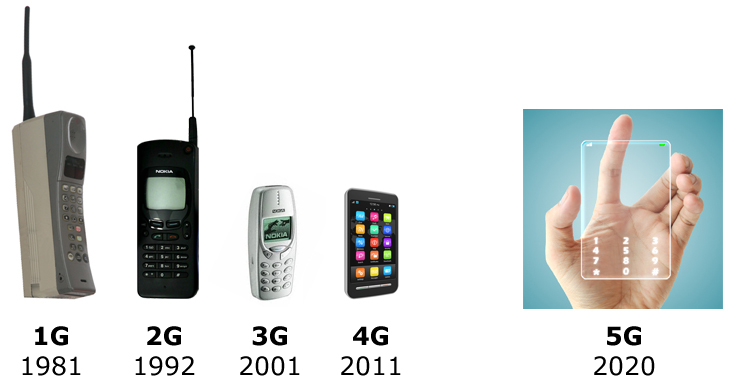
By 2020, the next major cellular wireless standard has been adopted.* This continues the trend seen since 1981 - in which a new mobile generation has appeared roughly every 10th year. The 5G family of standards is a major leap from previous generations in terms of power and functionality. Among its key features are:
By 2020, the next major cellular wireless standard has been adopted.* This continues the trend seen since 1981 - in which a new mobile generation has appeared roughly every 10th year. The 5G family of standards is a major leap from previous generations in terms of power and functionality. Among its key features are:
- Pervasive networks providing ubiquitous computing. The user can simultaneously be connected to several wireless access technologies and seamlessly move between them. These can be 2.5G, 3G, 4G or 5G networks, Wi-Fi, WPAN or any other contemporary access technology. Multiple, concurrent data transfer paths can be easily handled.
- Group cooperative relay. High bit rates are now available in a larger portion of the cell, especially to users in an exposed location in between several base stations. This is achieved by cellular repeaters, together with macro-diversity techniques (also known as group cooperative relay), as well as beam-division multiple access.
- IPv6, where a visiting care-of mobile IP address is assigned according to location and connected network.
- High-altitude stratospheric platform station (HAPS) systems, delivering high-speed Internet service to very large geographical areas.
- Wearable devices with AI capabilities, offering greater levels of user interaction and personalisation.
- One unified global standard with full compatibility, no matter what brand or model.
Texting by thinking
In addition to 5G, phones are becoming available with the option of texting by thought power alone.* This is achieved by a sensor-mounted headset worn by the user. The device contains brain-machine interface technology which analyses brain waves, converts them into digital signals and displays the resulting letters on-screen.*
In addition to 5G, phones are becoming available with the option of texting by thought power alone.* This is achieved by a sensor-mounted headset worn by the user. The device contains brain-machine interface technology which analyses brain waves, converts them into digital signals and displays the resulting letters on-screen.*
Some of the higher end models feature glasses or visors, with displays built into the lenses. This allows completely hands-free texting, effectively creating a form of virtual telepathy. The process is rather slow at this stage - requiring a high degree of mental concentration. It is more of a novelty for now. However, advances in coming years will enable smooth and fast interactions, revolutionising the world of communication.


No comments:
Post a Comment